
Ayurvedic Methods for Vision Support: The Navel as the Gateway of Life and a Center of Regulation
Ayurvedic Methods for Vision Support: The Navel as the Gateway of Life and a Center of Regulation
 valentinamicaj64@gmail.com
 Why Does Vision Weaken?
In Ayurvedic understanding, vision is not limited to the eyes alone. It is connected to the condition of the blood vessels, the liver, the nervous system, and the quality of internal metabolic fire — Agni.
One of the traditional explanations for reduced visual acuity, rapid eye fatigue, and poor night vision is dryness and fragility of the blood vessels supplying the eyeball. When vessels lose elasticity, tissue nourishment declines, oxygen delivery becomes less efficient, and the nervous system tires more quickly.
From an Ayurvedic perspective, this reflects an aggravation of Vata dosha — the principle of dryness, coldness, and depletion.
Ancient medicine, however, offers a surprisingly simple supportive approach — working through the navel.
The Navel — The Gate of Life
The navel is the first structure formed after conception. Through it, we were connected to our mother, receiving nourishment and life via the umbilical cord.
In Ayurveda, the navel area is called Nabhi — a center of vital force. It is believed that thousands of energy channels (nadis) intersect here. In Chinese medicine, this region corresponds to the lower dantian, considered a reservoir of life energy.
There is also an ancient concept known as “Pechoti” — described as a gland located behind the navel from which thousands of vessels and capillaries originate. Modern anatomy does not confirm the existence of a specific gland by this name. However, the abdominal wall is richly supplied with blood vessels and nerve endings, making this area an important reflexogenic zone.
Why Are Oils Applied to the Navel?
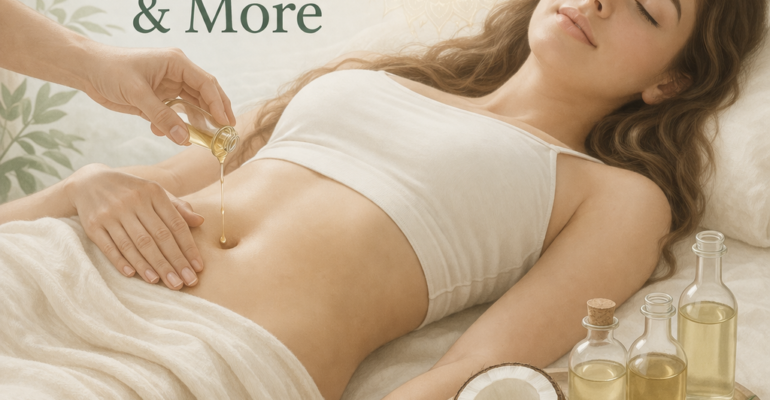
Ayurveda includes a traditional practice of applying natural oils to the navel area.
The reasoning behind this practice is that oils:
- reduce dryness (balance Vata dosha),
- support microcirculation,
- nourish the skin and fascial tissues,
- gently influence the autonomic nervous system through the abdominal region.
From a modern physiological perspective, the area around the navel is closely connected to the solar plexus — a major center of autonomic regulation. By relaxing this region, it may be possible to influence vascular tone and overall systemic balance.
Ayurvedic Recommendations for Eye Support
Coconut oil — For dry eyes and nervous exhaustion
Before bedtime, apply a small amount of warm coconut oil into the navel and spread it about 2 cm around it.
Traditionally, coconut oil is considered cooling and nourishing. It is believed to help reduce internal dryness and support comfort in cases of burning sensation and eye fatigue.
Mustard oil — For tremor, headaches, and poor circulation
A small amount applied to the navel area is traditionally used to stimulate circulation and provide warmth.
Castor oil — For joint discomfort
Three drops before sleep in the navel region are traditionally recommended to counteract dryness in joints.
For children’s abdominal discomfort
A small amount of warm oil placed in the navel followed by gentle clockwise massage for several minutes is traditionally used to soothe discomfort.
Essential Oils and Hormonal Balance
Essential oils such as peppermint, cypress, sage, and ginger are traditionally used to ease menstrual discomfort and support cycle balance. Important: Essential oils must always be diluted in a carrier oil and used with caution.
Self-Massage Technique for the Navel
“Activation” – Gently place your index finger into the navel indentation and apply very light pressure 6–10 times without force.
“Expansion” – Insert the fingertip and rotate clockwise, directing pressure outward rather than inward. Repeat 6–10 times. Traditionally, this is believed to support digestion.
“Compression” – Gather the skin to the left and right of the navel into a horizontal fold and gently squeeze 6–10 times. Then repeat vertically. This technique is traditionally said to tone the surrounding tissues.
“Pumping” – Place your palm over the navel and apply gentle rhythmic pressure 6–10 times during one exhalation. On inhalation, release and relax the abdomen. This movement is traditionally believed to replenish energy reserves.
How Is This Connected to Vision?
In Ayurvedic logic:
- The eyes are linked to the liver and blood.
- Blood circulation depends on vessel elasticity.
- Vessel tone is influenced by Vata.
- Vata is balanced by warmth, nourishment, and oil.
When dryness is reduced, tissue nourishment improves, the nervous system stabilizes, and vascular tension decreases. As a result, eye fatigue may lessen, and visual resilience — including adaptation to dim light — may improve.
Important Note
Applying oils to the navel is considered a supportive self-care practice.
It does not replace ophthalmologic evaluation or medical treatment for glaucoma, cataract, retinal disease, or vascular disorders.
However, as part of a daily ritual aimed at reducing stress and supporting vascular elasticity, it can serve as a gentle and grounding practice when used mindfully.
Life Energy Begins at the Center
The navel is more than an anatomical mark. It is a reminder of connection, nourishment, and the first pulse of life.
When we return our attention to the center of the body — to warmth, breath, and rhythm — it is not only the eyes that respond.
Vision is not merely the ability to see the world.
It is the ability to perceive it with clarity and presence.
