
Gratitude Is the Foundation of Health and Prosperity
Gratitude Is the Foundation of Health and Prosperity
 valentinamicaj64@gmail.com
 As a therapist, I witness every day how the human body responds not only to injuries, nutrition, or hormones — but first and foremost to inner state. Pain, chronic tension, hormonal imbalance, fatigue — very often these are not “malfunctions,” but adaptations to prolonged stress and internal conflict. And conversely, healing begins where safety, meaning, and gratitude appear.
What Happens in the Body When a Person Feels Gratitude
The phrase “1,200 chemical reactions” is often used metaphorically, and I want to be transparent: science does not operate with a precise number of reactions occurring during an emotion. However, research clearly confirms that gratitude initiates a large-scale cascade of neurochemical, hormonal, immune, and autonomic processes directed toward restoration.
This cascade truly involves hundreds and thousands of biochemical reactions because the body is a network — not a linear system.
Scientifically Observed Processes During Gratitude
When a person consciously experiences gratitude, the following changes occur in the body:
1. Activation of the Prefrontal Cortex
fMRI studies (Fox et al., 2015) show that gratitude activates the prefrontal cortex — the region associated with:
- self-regulation
- decision-making
- anxiety reduction
- impulse control
This means the person shifts out of survival mode.
2. Reduced Amygdala Activity
The amygdala is the brain’s fear center.
With regular gratitude practice, its reactivity decreases, lowering chronic anxiety and hypervigilance.
3. Autonomic Nervous System Balance
Gratitude:
- enhances parasympathetic tone
- activates the vagus nerve
- improves heart rate variability (HRV)
HRV is one of the key markers of health, longevity, and resilience.
4. Hormonal Regulation
In a state of gratitude:
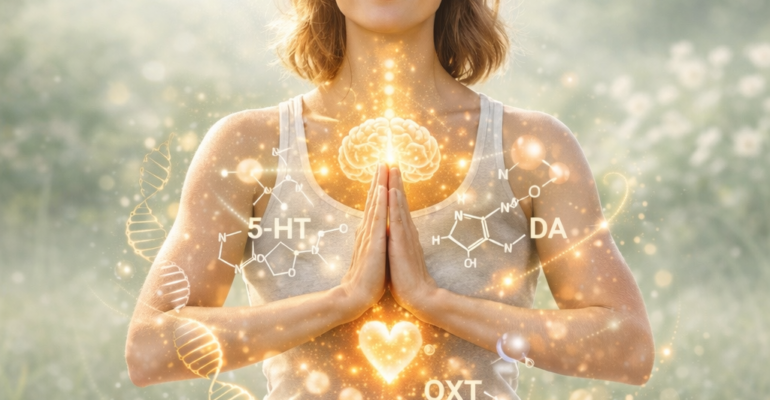
- ↑ Oxytocin (trust and bonding hormone)
- ↑ Dopamine (motivation and joy)
- ↑ Serotonin (emotional stability)
- ↓ Cortisol (stress hormone)
These findings are supported by research from Emmons & McCullough (2003–2010).
5. Immune Modulation
Through the psychoneuroendocrine-immune axis (PNEI):
- pro-inflammatory cytokines decrease
- tissue regeneration improves
- resilience to chronic illness increases
Why Gratitude Is Biologically Advantageous
From a biological perspective:
- fear = mobilization and breakdown
- gratitude = safety and restoration
When the body senses safety, it:
- relaxes fascial tension
- improves microcirculation
- normalizes breathing
- restores hormonal rhythms
- activates repair processes
Joy and gratitude are not abstract feelings — they are concrete physiological states.
Why We Must Work Through the Body First
It is important to understand: a person cannot always “just start feeling grateful” if their nervous system is locked in chronic stress. That is why we begin with the body.
In my practice, I use:
1. Osteopathic Regulation of the Nervous System
Gentle work with:
- the craniosacral system
- diaphragms
- the vagus nerve
- cerebrospinal fluid rhythms
This helps shift the body from sympathetic dominance into parasympathetic restoration.
2. Restoring the Felt Sense of Safety
When the body is no longer held in tension, the psyche automatically receives the signal:
“I am okay. It is safe now.” Only then does gratitude become accessible.
3. Somatic Anchoring of Positive States
We do not simply talk about gratitude — we teach the body to recognize and remember it:
- through breath
- through sensation
- through embodied presence
This builds new neural pathways.
4. Gradual Retraining of the Nervous System
The nervous system is plastic. With consistent support, it learns to choose restoration instead of tension.
What Is Important to Remember
- Gratitude is a skill, not a personality trait.
- Joy is a physiological state, not weakness.
- The body always moves toward health when it is not dominated by fear.
- We do not “treat symptoms” — we create conditions for self-regulation.
When the body learns to live in a state of gratitude,
it no longer needs to hold on to illness as a survival strategy.
And life begins to be felt again — with the whole heart.
Your Craniosacral osteopath,
Lena Steinberg-Shyroka
