
<font dir="auto" style="vertical-align: inherit;"><font dir="auto" style="vertical-align: inherit;">Як холестерин став «ворогом номер один» — і що ми пропустили</font></font>
Як холестерин став «ворогом номер один» — і що ми пропустили
 valentinamicaj64@gmail.com
 In the mid-20th century, cardiology adopted a simple and convincing model: dietary fat raises cholesterol, cholesterol causes atherosclerosis, and atherosclerosis leads to heart attacks and strokes. It was logical, clear, and easy to communicate. But human physiology is more complex than a single linear equation.
Today, a growing body of research is challenging the oversimplified demonization of cholesterol and dietary fat. It is becoming increasingly clear that the problem was never cholesterol itself, but the broader metabolic context in which it functions.
The Origins of the Fat Hypothesis
In the 1950s and 1960s, the work of Ancel Keys and the Seven Countries Study strongly influenced public health policy. The study suggested a correlation between saturated fat intake and cardiovascular mortality. However, over time, the methodology was criticized for selective country inclusion, limited control for sugar consumption, and insufficient consideration of lifestyle variables.
Despite these concerns, the message became dominant. In 1977, the United States issued its first national dietary guidelines recommending a reduction in fat consumption.
When Fat Was Removed — What Replaced It?
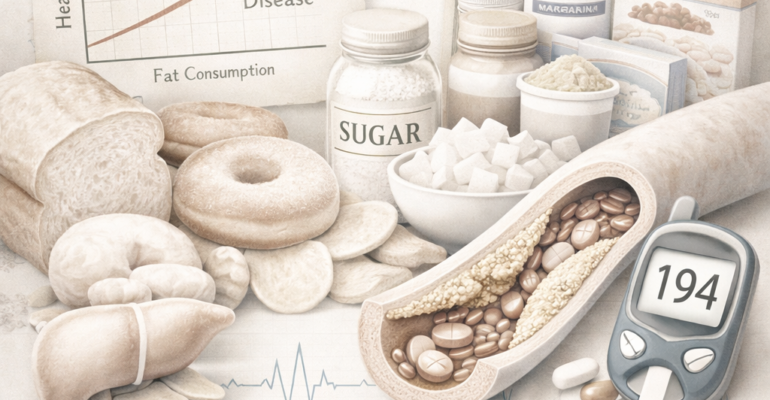
The food industry responded quickly. Fat was removed from products. Sugar and refined carbohydrates were added to maintain flavor and texture. Low-fat marketing became a powerful commercial tool.
From the 1980s onward, rates of obesity and type 2 diabetes rose sharply. According to data from the Centers for Disease Control and Prevention, the prevalence of diabetes in the United States has more than tripled over recent decades.
What Modern Research Shows
A 2010 meta-analysis published in the American Journal of Clinical Nutrition did not find clear evidence linking saturated fat intake with cardiovascular disease. In 2017, the large international PURE study published in The Lancet suggested that high carbohydrate intake was associated with increased mortality, whereas moderate fat consumption was not.
Excess sugar and refined carbohydrates are now recognized as key contributors to metabolic dysfunction. High sugar intake increases triglycerides, lowers HDL cholesterol, promotes the formation of small dense LDL particles, and contributes to chronic inflammation. Insulin resistance is increasingly understood as a central mechanism in the development of atherosclerosis.
A Common Misconception: Cholesterol Rises Only Because of Fatty Food
Diet is only one factor influencing cholesterol levels, and often not the primary one.
Genetics plays a major role. Familial hypercholesterolemia is a hereditary condition in which the body produces excessive cholesterol regardless of dietary habits. Even with strict nutrition, LDL levels may remain high.
Physical inactivity contributes to lower HDL levels and unfavorable lipid balance.
Excess sugar and refined carbohydrates can significantly raise triglycerides and LDL, even in the absence of high fat intake.
Chronic stress and poor sleep increase cortisol levels, which affect lipid metabolism and liver function.
Liver and gallbladder dysfunction may impair cholesterol processing and elimination.
Hormonal imbalances also influence cholesterol. In hypothyroidism, lipid levels frequently rise. In women, menopause and declining estrogen levels often shift the lipid profile.
Why Cholesterol Is Essential
Cholesterol is a fundamental structural component of cell membranes. It is required for the synthesis of steroid hormones. It is necessary for vitamin D production. It participates in tissue repair and regeneration.
Cholesterol is not an enemy. It is a vital biological molecule. Problems arise when metabolic regulation is disturbed. Practical Steps to Support Healthy Lipid Balance:
- Increase regular physical activity such as walking, swimming, or dancing.
- Consume more plant fiber from vegetables, seeds, bran, and legumes.
- Include foods that support lipid metabolism such as oats, avocado, nuts, flaxseed, artichokes, and leafy greens.
- Assess thyroid hormones and liver function if cholesterol remains elevated.
- Consider advanced testing including Lipoprotein(a), ApoB, and homocysteine to better evaluate cardiovascular risk.
- Support the body structurally and neurologically through regular craniosacral osteopathic care at least once every three months.
Conclusion
The history of cholesterol illustrates how a simplified theory can shape global nutrition policy for decades. Current evidence suggests that the metabolic crisis we see today is not primarily the result of natural dietary fats, but of excessive sugar, refined carbohydrates, chronic stress, and the loss of a holistic understanding of human physiology.
Rather than searching for a single enemy, it may be wiser to restore balance within the whole system.
Your craniosacral osteopath
Lena Steinberg-Shyroka
