
Psoriasis, nervous system regulation and holistic treatment
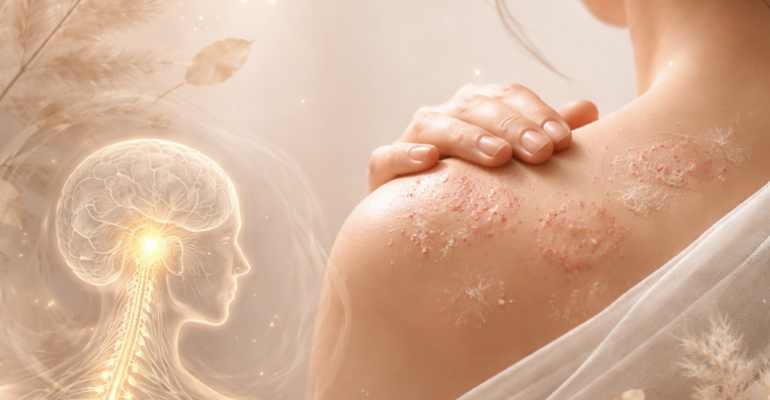
Psoriasis, nervous system regulation and holistic treatment
 valentinamicaj64@gmail.com
 Psoriasis is a chronic autoimmune skin condition. But in 15 years of practice, I have never seen psoriasis as “just a skin problem. Every single time, it is a story about the nervous system. About chronic stress.
About a person who has been holding too much for too long.
A 38-year-old woman came to see me with a 10-year history of psoriasis. Her flare-ups appeared after emotional conflicts, intense work pressure, and lack of sleep. She had tried topical treatments, steroids, restrictive diets. Improvements would come — but only temporarily. What hurt her most was not even the scaling. It was the shame and the constant fear of the next flare.
At our first session, I did not see “a skin disease.” I saw a dysregulated nervous system. Shallow breathing. A tight diaphragm. A dense, restricted abdomen. Cold hands. Her body was living in chronic sympathetic activation — the “fight or flight” mode.
When the nervous system stays in survival mode for months or years, the immune system becomes unstable. Inflammation increases. Gut function becomes compromised. The microbiome shifts. And the skin — our largest organ — begins to express what the body cannot regulate internally. So we did not begin with the skin.
We began with nervous system regulation.
Through gentle osteopathic treatment and craniosacral therapy, we worked to release diaphragmatic tension, improve visceral mobility of the liver and intestines, and restore parasympathetic balance. Alongside manual therapy, we introduced anti-inflammatory nutrition, microbiome support, and medicinal mushrooms such as reishi and chaga for immune modulation. Most importantly, we gradually helped her body move out of chronic stress physiology.
After 6–8 weeks, her flare-ups became milder. Within a few months, her skin improved by about 70%. But more importantly — she stopped living in anticipation of the next crisis. Her sleep deepened. Her body felt warmer. Her reactions softened. Psoriasis is chronic inflammation. And chronic inflammation is very often linked to nervous system dysregulation.
This is why osteopathy can play such an important role in a holistic psoriasis treatment plan. We do not “treat the skin.” We help the body shift from survival mode into restoration mode — into parasympathetic regulation, where tissue repair and immune balance become possible.
Nutrition matters. In psoriasis, reducing sugar, alcohol, gluten, and processed foods while increasing greens, omega-3 fatty acids, and anti-inflammatory spices can significantly reduce systemic inflammation. The gut and liver are central in this process. If detoxification pathways and microbiome balance are compromised, the skin will reflect it.
Gentle skin care, mineral baths, natural oils — these are supportive. But deep healing begins when the nervous system feels safe.
I often tell my patients: psoriasis is not your enemy. It is a signal. The body is not attacking you. It is trying to adapt to overload.
Sustainable remission is possible. Not through fighting your body, but through working with it — regulating the nervous system, supporting immune balance, improving gut health, and restoring emotional resilience.
If you live with psoriasis, you are not broken.
Your body is doing its best to cope with chronic stress.
And sometimes healing does not begin with a cream.
It begins with a sense of safety inside your own body.
